Age-Appropriate Tasks: What Your Child Can Really Do at 3, 5, 8, and 12
Posted on February 27, 2026 · 5 min read
Why Age Matters More Than You Think
Here's a scene most parents know too well: you ask your 4-year-old to "clean up," and they stare at you like you've spoken a foreign language. Or you hand your 10-year-old a broom and they act like they've never seen one before.
The problem isn't laziness — it's misalignment. When we give kids tasks that don't match their developmental stage, we set everyone up for frustration. Too hard, and they shut down. Too easy, and they get bored.
Research from the University of Minnesota's Marjorie Payette Study found that children who began age-appropriate chores by age 3–4 were more likely to be self-sufficient, have better relationships, and achieve academic success by their mid-twenties. The key word: age-appropriate.
Ages 3–4: The Helper Stage
At this age, children are driven by imitation. They want to do what you do. Their motor skills are developing rapidly, but their attention span is short — about 5 to 8 minutes for a focused task.
What they can do:
- Put toys back in a bin (with visual cues like picture labels)
- Place dirty clothes in a hamper
- Wipe up small spills with a cloth
- Help set the table (unbreakable items)
- Water plants with a small watering can
- Feed pets with supervision
Developmental benefit: These tasks build sequencing skills — the ability to follow a 1-2 step process. They also develop gross motor coordination and a sense of belonging ("I help my family").
Ages 5–7: The Skill-Builder Stage
Children in this range can follow multi-step instructions and are developing a sense of personal responsibility. Research published in the Journal of Developmental & Behavioral Pediatrics shows that children who regularly complete chores at this age show improved executive function — the brain skills that control planning, focus, and impulse regulation.
What they can do:
- Make their bed (won't be perfect — and that's fine)
- Sort laundry by color
- Set and clear the table
- Sweep floors with a child-sized broom
- Put away groceries (lower shelves)
- Tidy their own room with a checklist
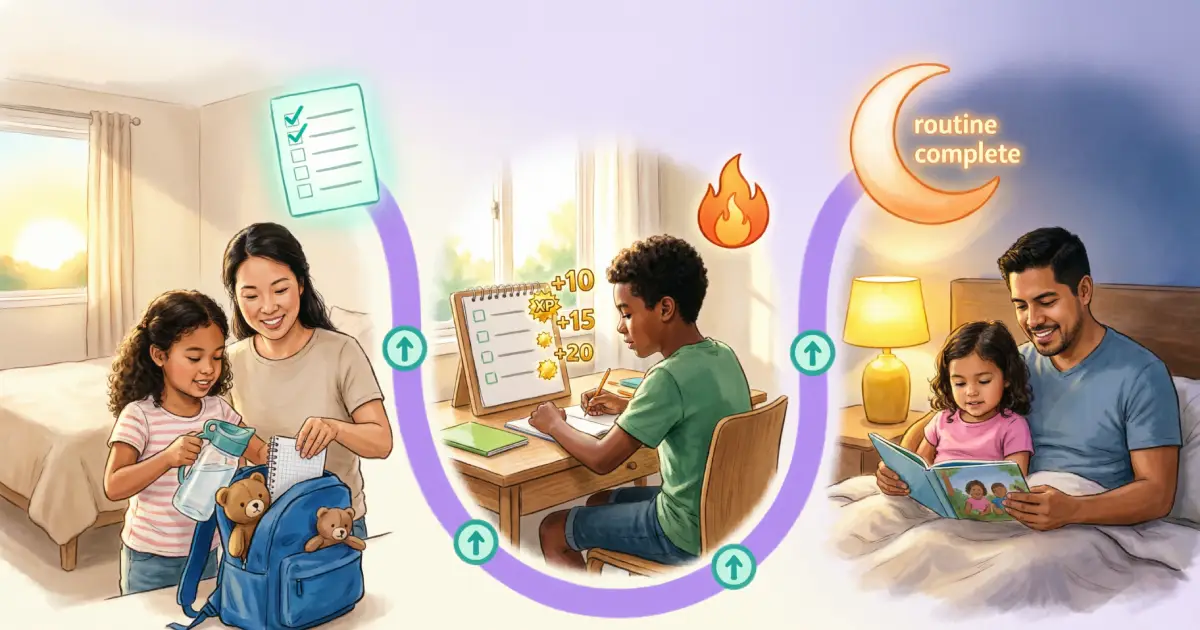
- Pack their school bag
Developmental benefit: Multi-step tasks develop working memory and planning ability — two core executive functions that predict academic success. The American Academy of Pediatrics notes that routine responsibilities help children develop emotional regulation and self-discipline.
Ages 8–10: The Independence Stage
This is where real independence begins to form. Children can handle more complex tasks, work with minimal supervision, and start understanding consequences. A 2019 study in Child Development found that children given consistent household responsibilities during these years show greater empathy and prosocial behavior.
What they can do:
- Load and unload the dishwasher
- Vacuum or mop common areas
- Prepare simple meals (sandwiches, cereal, microwave items)
- Take out the garbage and recycling
- Fold and put away their own laundry
- Clean bathrooms with safe cleaning products
- Help with younger siblings (supervised)
- Manage their own homework routine
Developmental benefit: These tasks build time management, problem-solving, and responsibility transfer. Kids begin to internalize that actions have consequences — and that their contributions genuinely matter.
Ages 11–13: The Mastery Stage
Pre-teens are capable of nearly all household tasks with proper instruction. More importantly, this is the critical window for developing intrinsic motivation — the inner drive to do things because they matter, not just for external rewards.
What they can do:
- Cook full meals with supervision
- Do their own laundry start to finish
- Clean the kitchen thoroughly
- Mow the lawn or do yard work
- Babysit younger siblings for short periods
- Manage a simple budget or shopping list
- Plan and execute a family activity
Developmental benefit: Research from the Harvard Grant Study — one of the longest-running studies of human development — found that childhood chores were one of the strongest predictors of adult success, even more than IQ or family income. Tasks at this age teach ownership, leadership, and real-world competence.
The Mistake Most Parents Make
The biggest mistake isn't giving kids too many tasks. It's waiting too long to start — and then expecting perfection when they do begin.
Children who are suddenly introduced to chores at age 10 without prior experience often resist — not because they're lazy, but because the habit loop was never established. The earlier you start (even imperfectly), the more natural responsibility becomes.
The second mistake is treating all tasks equally. A 5-year-old sorting socks and an 8-year-old sorting socks aren't doing the same task developmentally. For the younger child, it's a fine motor exercise. For the older child, it's a routine below their capability that breeds boredom.
How Questmo Matches Tasks to Your Child's Stage
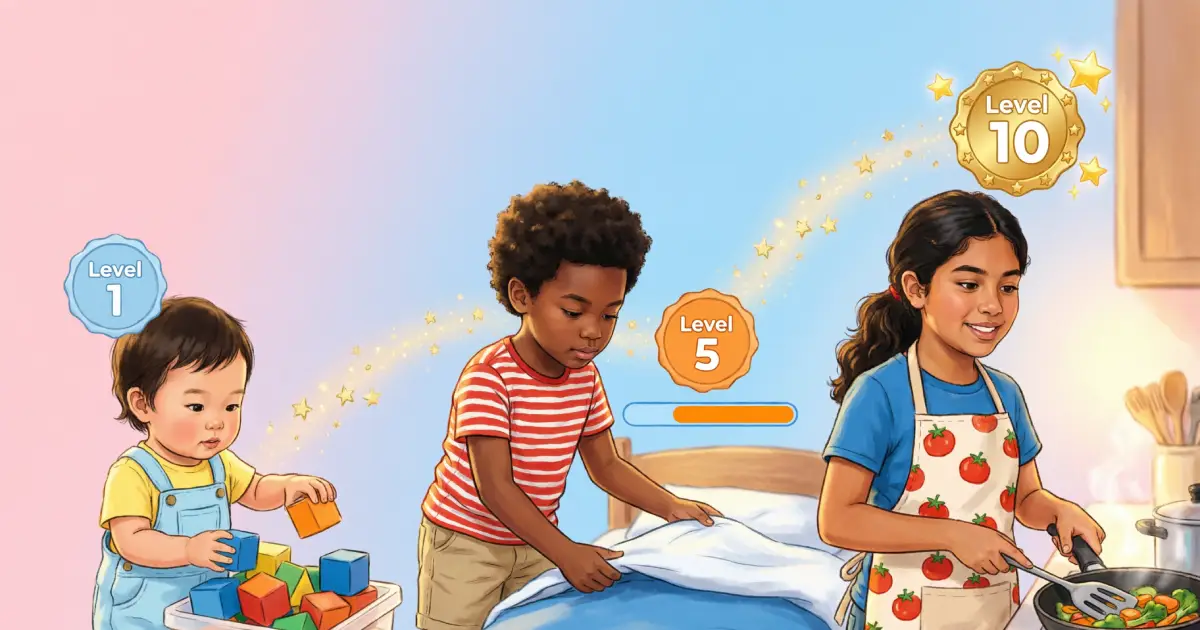
This is exactly why Questmo was designed the way it is. Instead of a flat chore list, Questmo lets you assign quests with difficulty levels and XP values that match your child's age and ability.
With Questmo, you can:
- Set difficulty levels so younger kids get simpler quests while older kids get challenging ones
- Use XP scaling — harder tasks earn more experience points, teaching proportional reward
- Let kids track their own level progression so they can see growth over time
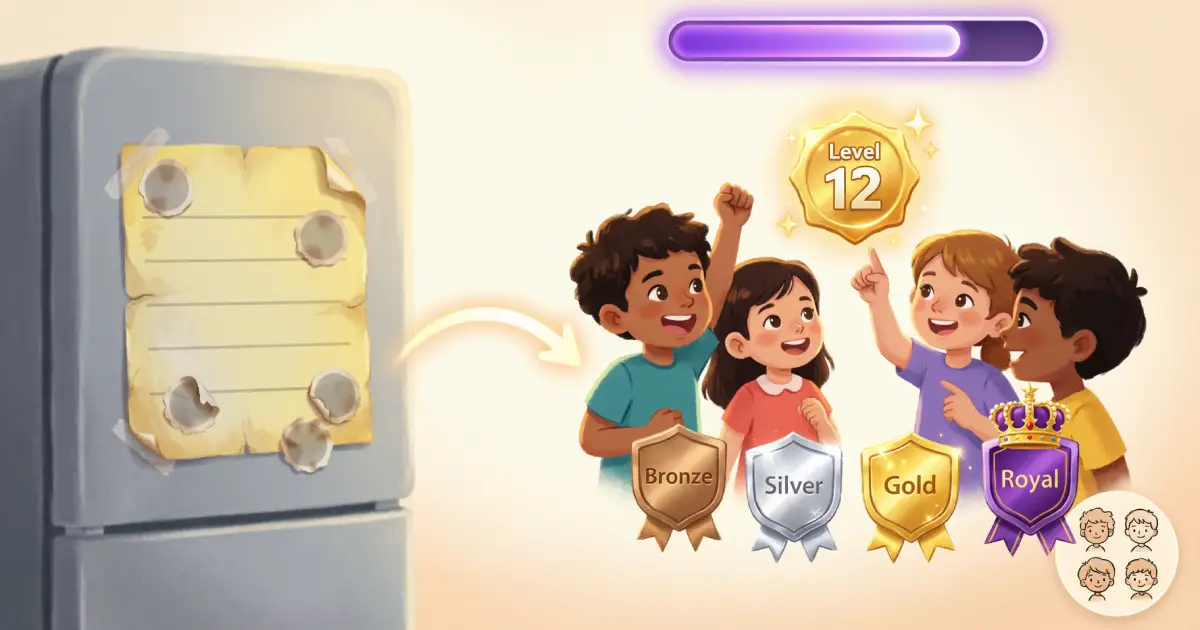
- Unlock 75 achievements across 4 tiers (Bronze, Silver, Gold, Royal) — each designed to match increasing capability
- Require photo proof for tasks, so you can verify quality without hovering
- Set recurring quests that build daily habits automatically
Every child develops at their own pace. Questmo gives parents the flexibility to meet their child exactly where they are — and gently push them toward the next stage. Download Questmo and turn developmental milestones into adventures your child actually wants to complete.
References
- Rossmann, M. (2002). "Involving Children in Household Tasks: Is It Worth the Effort?" University of Minnesota College of Education and Human Development. University of Minnesota
- Tepper, D.L., Howell, T.J., & Bennett, P.C. (2022). "Executive Functions and Household Chores: Does Engagement in Chores Predict Children's Cognition?" Australian Occupational Therapy Journal, 69(4), 432-445. doi.org
- American Academy of Pediatrics. (2019). "The Power of Play: A Pediatric Role in Enhancing Development in Young Children." Pediatrics, 142(3). aap.org
- Vaillant, G.E. (2012). Triumphs of Experience: The Men of the Harvard Grant Study. Harvard University Press. hup.harvard.edu