Why XP and Levels Work Better Than Sticker Charts: The Science of Gamification for Kids
Posted on February 28, 2026 · 6 min read
The Sticker Chart Graveyard
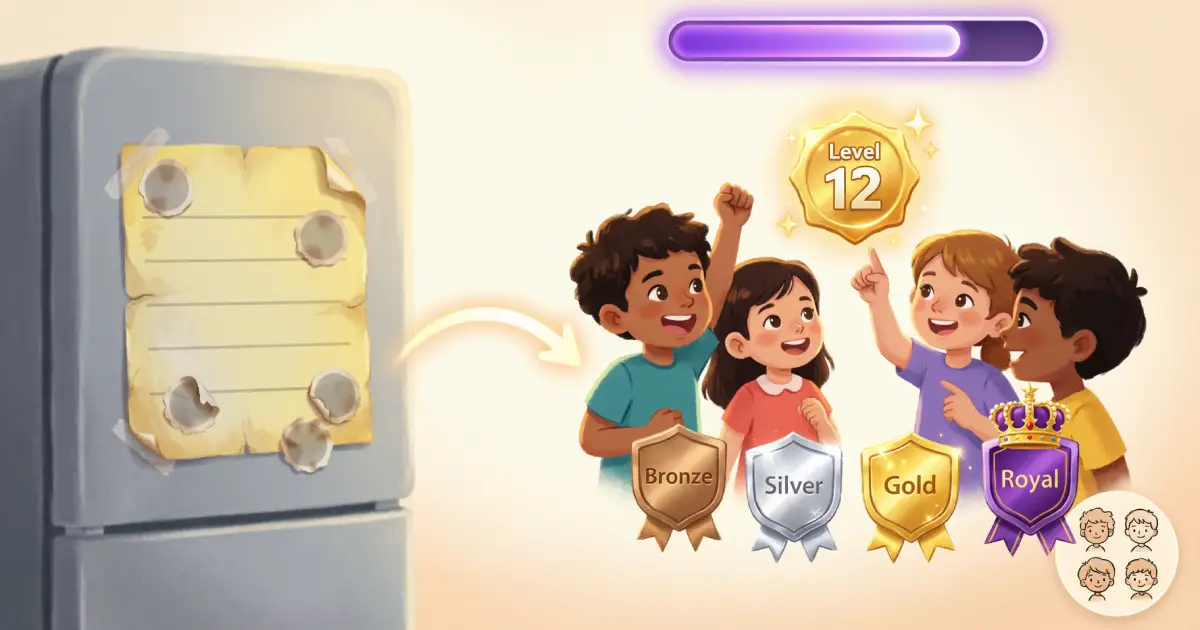
Every parent has been there. You print a colorful sticker chart, stick it to the fridge with optimism, and for the first week it's magical. Your child races to complete their chores, eyes wide with excitement over that shiny gold star. Week two, the enthusiasm dips. By week three, the chart is buried under takeout menus and the stickers are decorating the cat.
You're not a bad parent. The sticker chart isn't even a bad idea — it's just an incomplete one. And behavioral science can explain exactly why it fails, and what works instead.
Why Sticker Charts Stop Working: The Habituation Problem
Sticker charts rely on what psychologists call a fixed ratio reinforcement schedule — do the thing, get the reward, every single time. It's predictable. And predictability is the enemy of sustained motivation.
Research by B.F. Skinner demonstrated decades ago that variable ratio reinforcement — where rewards come at unpredictable intervals — produces far more persistent behavior than fixed schedules. It's the same principle behind why video games are so engaging: you never know exactly when the next power-up, rare drop, or level unlock will appear.
Sticker charts also suffer from what psychologists call hedonic adaptation. The first sticker feels amazing. The twentieth feels routine. By the fiftieth, your child's brain has fully adapted to the stimulus and the dopamine response flatlines. The reward hasn't changed, so the motivation evaporates.
Self-Determination Theory: What Kids Actually Need
In the 1980s, psychologists Edward Deci and Richard Ryan developed Self-Determination Theory (SDT), one of the most robust frameworks for understanding human motivation. Their research, validated across hundreds of studies, identified three fundamental psychological needs that drive sustained engagement:
- Autonomy — the feeling of choice and ownership over your actions
- Competence — the sense that you're getting better at something meaningful
- Relatedness — feeling connected to others who care about your progress
Sticker charts score poorly on all three. The child doesn't choose the reward system. There's no sense of growing mastery — sticker number forty-seven feels identical to sticker number three. And the chart is a solo experience with no social dimension.
Gamification, when designed well, hits all three needs directly.
How XP and Levels Tap Into Deeper Motivation
When a child earns experience points (XP) for completing a task, something psychologically different happens compared to receiving a sticker. XP accumulates. It builds toward something — a level, a milestone, a visible marker of progress. This creates what game designers call a progress loop, and research from the Journal of Educational Psychology confirms that visible progress indicators significantly increase task persistence in children aged 6-12.
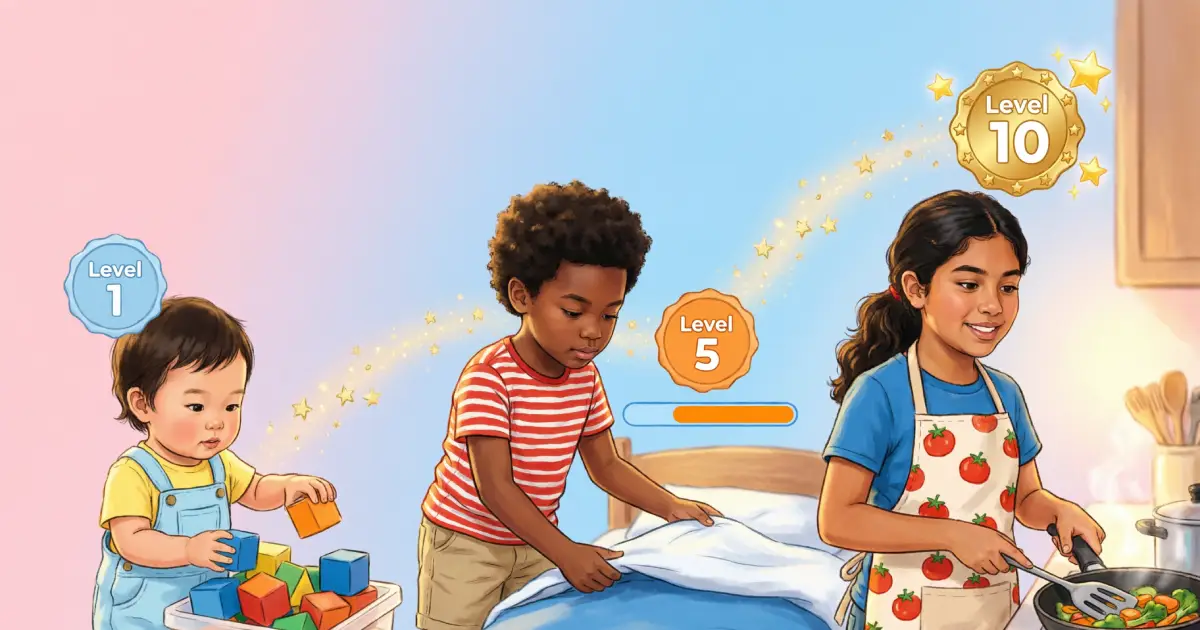
Leveling up provides a powerful competence signal. When your child moves from Level 7 to Level 8, their brain registers genuine growth. Unlike a sticker (which is the same reward every time), a new level represents a threshold crossed — proof they're building real capability. This aligns directly with Deci and Ryan's competence need.
The variable reward structure also changes. In a well-designed gamification system, XP values differ by task difficulty, bonus XP can appear unexpectedly, and achievements unlock at surprising moments. A 2013 meta-analysis published in Computers & Education found that gamification elements improved learning outcomes and motivation by 14% compared to non-gamified approaches, with progression systems being the most effective element.
Achievements and the Power of Surprise
Achievements — those delightful badges that pop up when you've done something notable — operate on a principle that neuroscientist Wolfram Schultz calls reward prediction error. Your brain releases the most dopamine not when it receives an expected reward, but when it receives an unexpected one.
A child who completes their fifth quest in a row and suddenly unlocks a "Consistency Champion" achievement gets a neurochemical reward that no sticker chart can match. It wasn't expected. It wasn't promised. It simply appeared because they were doing the right thing — and that makes it feel earned in a way external rewards rarely do.
Multi-tier achievement systems amplify this effect. When achievements have layers — say, Bronze, Silver, Gold, and Royal tiers — children experience what psychologist Mihaly Csikszentmihalyi described as flow state: they're always operating at the edge of their current ability with the next challenge just within reach. They completed Bronze? Silver is right there, waiting.
The Social Ingredient Sticker Charts Miss
Sticker charts are inherently isolated experiences. A chart on your fridge doesn't connect your child to anyone else's progress or create shared celebration moments.
Gamification systems thrive on relatedness. When a family can see each other's levels, celebrate achievements together, and share in the progress, motivation stops being about individual stickers and becomes about collective adventure. Research from a 2019 study in Frontiers in Psychology confirmed that social gamification elements — shared progress, group goals, and visible achievements — increased sustained engagement by 34% compared to individual reward systems.
Age-Appropriate Engagement Patterns
One of the most important findings in gamification research is that the effective elements vary by age:
- Ages 5-7: Visual progress (filling a bar, watching a number climb) is the strongest motivator. Simple, immediate feedback loops work best.
- Ages 8-10: Achievement unlocking and collection mechanics become powerful. Children at this stage love completing sets and reaching milestones.
- Ages 10-12: Social comparison and mastery tiers drive engagement. Children want to see how they rank and aspire to the next level of competence.
A well-designed gamification system scales across all these stages — the same underlying mechanics (XP, levels, achievements) feel different and appropriate at every age.
How Questmo Brings the Science to Life
This is exactly what Questmo was built for. Every element of the app's gamification system is grounded in the behavioral science above — from variable XP rewards that prevent habituation, to a 50-level progression that sustains competence growth for years, not weeks.
With Questmo, you can:
- Assign tasks as quests with XP rewards that vary by difficulty — so harder challenges feel proportionally more rewarding
- Watch your kids level up from 1 to 50, building visible proof of their growing responsibility
- Let them chase 55+ achievements across four tiers — Bronze, Silver, Gold, and Royal — with surprises they don't see coming
- Unlock and collect premium avatars that reward consistency and milestone completion
- Set up a reward catalog where kids redeem earned points for real-world treasures you define
- Track progress together in a shared family circle — both parents included — so motivation becomes a team sport
Sticker charts gave parents a starting point. Gamification gives families a system that grows with their children. Download Questmo and give your kids a motivation engine that doesn't run out of fuel after two weeks.
References
- Deci, E.L. & Ryan, R.M. (2000). "The 'What' and 'Why' of Goal Pursuits: Human Needs and the Self-Determination of Behavior." Psychological Inquiry, 11(4), 227-268. doi.org
- Hamari, J., Koivisto, J., & Sarsa, H. (2014). "Does Gamification Work? A Literature Review of Empirical Studies on Gamification." 47th Hawaii International Conference on System Sciences. doi.org
- Csikszentmihalyi, M. (1990). Flow: The Psychology of Optimal Experience. Harper & Row. harpercollins.com
- Dichev, C. & Dicheva, D. (2017). "Gamifying Education: What Is Known, What Is Believed and What Remains Uncertain." International Journal of Educational Technology in Higher Education, 14(9). doi.org
- Schultz, W. (2016). "Dopamine Reward Prediction Error Signalling: A Two-Component Response." Nature Reviews Neuroscience, 17, 183-195. doi.org
- Sailer, M. & Homner, L. (2020). "The Gamification of Learning: A Meta-Analysis." Educational Psychology Review, 32, 77-112. doi.org