The Ultimate Family Routine System: How to End the Daily Chaos
Posted on February 27, 2026 · 7 min read
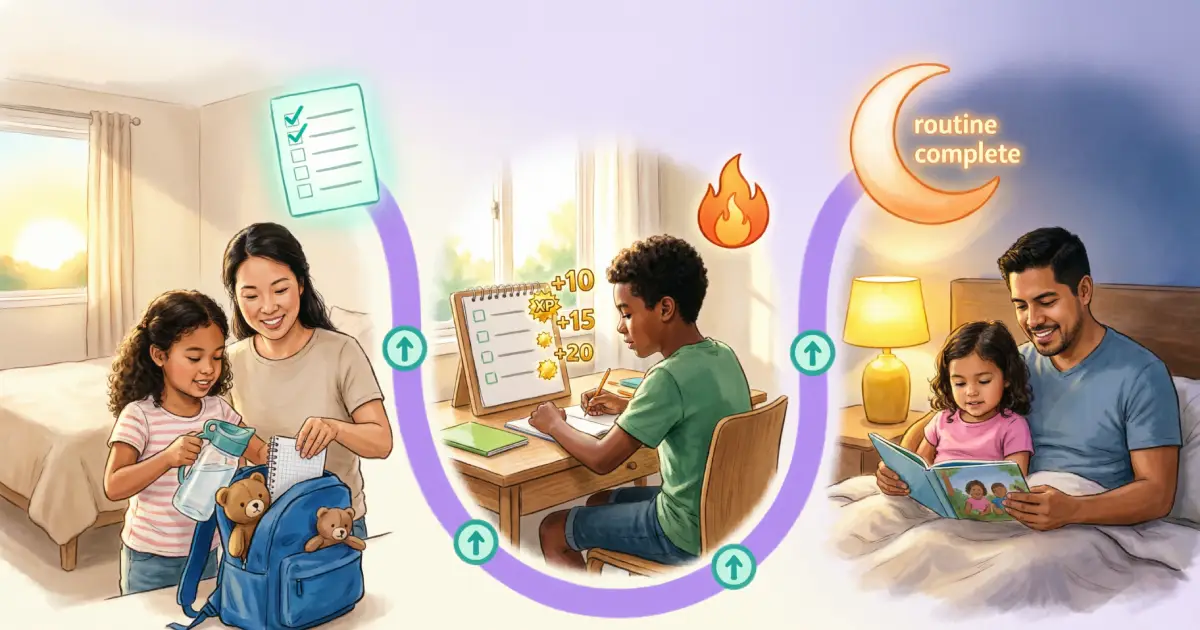
The 6 AM Meltdown Nobody Talks About
It's 7:15 AM. School starts in 30 minutes. One child can't find their shoes. The other is still in pajamas eating dry cereal on the couch. You've said "hurry up" eleven times. Nobody has brushed their teeth. You're already exhausted, and the day hasn't even begun.
Sound familiar? You're not alone — and you're not failing. According to a 2015 survey by the American Psychological Association, 73% of parents report that family obligations are a significant source of stress. The mornings, the after-school scramble, the bedtime resistance — these aren't signs of a broken family. They're signs of a family without a system.
The good news? Decades of research on habit formation and child development show that routines don't just reduce stress — they fundamentally change how children behave, feel, and grow. And you don't need a color-coded spreadsheet to make it work.
Why Routines Are More Powerful Than Rules
Most parents default to rules: "Be ready by 7:30." "Do your homework before screen time." "Brush your teeth before bed." Rules tell children what to do. Routines show them when and how to do it — and eventually, make the behavior automatic.
A landmark study published in the Journal of Developmental & Behavioral Pediatrics found that children with consistent household routines showed better emotional regulation, improved social skills, and fewer behavioral problems. The researchers concluded that predictability is one of the most underrated gifts parents can give.
Dr. Wendy Mogel, clinical psychologist and author of The Blessing of a Skinned Knee, explains it simply: "Routines are the rhythm that lets children relax into their day. When a child knows what comes next, they spend less energy resisting and more energy engaging."
Research by Charles Duhigg, author of The Power of Habit, shows that habits operate on a three-part loop: cue, routine, reward. When families build this loop into daily transitions — morning, after-school, bedtime — the resistance fades because the brain shifts from decision-making to autopilot.
The Three Routines Every Family Needs
You don't need to schedule every minute of the day. Research consistently points to three critical transition periods where routines have the highest impact:
1. The Morning Launch Routine
Mornings set the emotional tone for the entire day. A study in the Journal of Family Psychology found that families who followed a structured morning routine reported 40% less daily conflict.
The system:
- Wake-up anchor — Same time every day, with a consistent signal (alarm, music, a gentle wake-up call)
- Sequence of 4-5 tasks — Get dressed, eat breakfast, brush teeth, pack bag, shoes on. Post the order visually for kids under 8
- Built-in buffer — Add 10-15 minutes of margin. If the bus comes at 7:45, the routine ends at 7:30
- Completion reward — Free play, a short video, or simply verbal praise. The reward closes the habit loop
Age-appropriate tips:
- Ages 3-5: Use a picture-based routine chart. Each task has an illustration they can check off with a sticker
- Ages 5-8: Give them a written checklist they manage themselves. Let them choose the order of non-essential tasks
- Ages 8-12: Let them set their own alarm and manage the routine independently. Your role shifts to checking the result, not directing every step
2. The After-School Reset Routine
The transition from school to home is one of the most volatile moments in a family's day. Children arrive overstimulated, hungry, and emotionally depleted. Research on cognitive load theory shows that children's executive function resources are significantly reduced after a full school day.
The system:
- Decompress window — 15-20 minutes of unstructured time. Snack, quiet play, or just sitting. No questions about school yet
- Task block — Homework, chores, or practice. Keep it under 45 minutes for ages 5-8 and under 90 minutes for ages 8-12
- Free time — The natural reward. Screen time, outdoor play, or hobbies. Earned through completing the task block
3. The Bedtime Wind-Down Routine
The American Academy of Pediatrics recommends consistent bedtime routines not just for sleep quality, but for emotional bonding and literacy development. Their research shows that a predictable 20-30 minute wind-down reduces bedtime resistance by up to 50%.
The system:
- 30-minute warning — A consistent cue that the wind-down has begun. Screens off
- Hygiene sequence — Bath or shower, brush teeth, pajamas
- Connection ritual — Reading together, gratitude sharing, or a brief conversation about the day
- Lights out — Same time every night, with a consistent final signal ("Goodnight, adventurer")
The Science of Making It Stick
Building a routine is one thing. Making it last is another. Research from the European Journal of Social Psychology by Phillippa Lally and colleagues found that new habits take an average of 66 days to become automatic — not the commonly quoted 21 days.
Here's what the research says works:
- Start with one routine — Don't overhaul the entire day at once. Pick the most painful transition (usually mornings) and nail that first
- Make it visible — Visual charts, printed schedules, or a family whiteboard. A 2018 study in Child Development confirmed that external visual cues dramatically improve task completion in children under 10
- Use consistent rewards, not bribes — A reward is agreed upon in advance as part of the system. A bribe is offered in the moment to stop resistance. The former builds habits; the latter destroys them
- Expect imperfection for 8-10 weeks — Habits form through repetition, not perfection. Missing a day doesn't reset progress
- Involve children in the design — A 2020 study in the Journal of Child and Family Studies found that children who helped create their routines were 30% more likely to follow them consistently. Let them choose task order, pick their reward, or name their routine
What to Do When Routines Break Down
They will break down. Vacations, illness, schedule changes, and just plain bad days will knock your system off track. This is normal.
The key is what psychologists call routine resilience — the ability to return to the system after a disruption without starting over. Here's how:
- Name it: "We're off our routine today. That's okay. We'll get back on track tomorrow"
- Keep one anchor: Even on chaotic days, maintain one element of the routine (usually bedtime). This gives the brain a consistency signal
- Avoid blame: Routines fail because of systems, not people. If a routine keeps breaking at the same point, redesign that step — don't punish the child
How Questmo Makes Family Routines Effortless
This is exactly what Questmo was built for. Instead of paper charts that get ignored and reminder apps that feel like nagging, Questmo turns your family routine into an adventure your kids actually want to follow.
With Questmo, you can:
- Set up recurring quests for morning, after-school, and bedtime routines — assign once, repeat automatically
- Assign tasks as quests with XP rewards and difficulty levels that match each child's age
- Watch your kids level up as they build consistent habits day after day
- Let them earn and unlock premium avatars and achievements that celebrate their streaks
- Set up a reward catalog where kids redeem their earned points for real family rewards
- Track progress with family analytics that show you which routines are working — and which need adjusting
- Manage everything from a single family circle — both parents included, everyone on the same page
Your family doesn't need more reminders, more nagging, or more willpower. You need a system — and a little bit of adventure magic. Download Questmo and turn your daily chaos into a routine your whole family actually follows.
References
- American Psychological Association. (2015). "Stress in America: Paying with Our Health." APA Stress in America Survey. apa.org
- Mindell, J.A., Williamson, A.A. (2018). "Benefits of a Bedtime Routine in Young Children: Sleep, Development, and Beyond." Sleep Medicine Reviews, 40, 93-108. doi.org
- Lally, P., van Jaarsveld, C.H.M., Potts, H.W.W., & Wardle, J. (2010). "How Are Habits Formed: Modelling Habit Formation in the Real World." European Journal of Social Psychology, 40(6), 998-1009. doi.org
- Duhigg, C. (2012). The Power of Habit: Why We Do What We Do in Life and Business. Random House. charlesduhigg.com
- Fiese, B.H., Tomcho, T.J., Douglas, M., et al. (2002). "A Review of 50 Years of Research on Naturally Occurring Family Routines and Rituals." Journal of Family Psychology, 16(4), 381-390. doi.org
- American Academy of Pediatrics. (2016). "Media and Young Minds." Pediatrics, 138(5). aap.org